
The short answer
Start your Shinjuku evening at the free observation deck of the Tokyo Metropolitan Government Building around 5:30pm, then walk to Omoide Yokocho for yakitori and beer as the alley fills up. Cross into Kabukicho to take in the neon and grab kushiage at a standing bar, then finish the night in Golden Gai, where more than 200 tiny bars pack six alleys that most visitors can't navigate alone. That four-stop loop — observation deck to Golden Gai — is the most satisfying way to spend a single night in Shinjuku, and you can do it entirely on foot because all four areas sit within about a 15-minute walk of each other.
Want to do this with a local? Shinjuku Food & Drink Night Tour — From $130 (~¥20,500), small group, led by our own guides.
5:00pm–6:30pm: Get your bearings from above
The Tokyo Metropolitan Government Building in Nishi-Shinjuku has two free observation floors that open in the early evening. Arriving around 5:30pm on a clear day gives you the best of both worlds: daylight views across the city and, as the sky darkens, the slow emergence of Shinjuku's neon below you. No ticket queue, no cover charge — just take the dedicated elevator from the main building's first floor. Check the official website for current hours before you go, as the north and south towers operate on different schedules and one is sometimes closed for maintenance.
Use this half hour to orient yourself. You can see Omoide Yokocho's roof almost directly below, the Kabukicho arch a short walk east, and the low cluster of Golden Gai just beyond. Having that mental map makes the rest of the night feel like exploration rather than guesswork. Come back down around 6:15pm and walk ten minutes east toward the station.
6:30pm–8:30pm: Omoide Yokocho, then Kabukicho
Omoide Yokocho — Memory Lane — is a postwar alley of roughly 60 tiny eateries tucked against the west exit of Shinjuku Station. It is best entered just after dark, when the charcoal smoke and red lanterns are at their most atmospheric. Most stalls seat fewer than ten people, menus are in Japanese only, and prices for a skewer of yakitori typically run ¥300–¥600 per stick with beer or a highball on top. The stalls are small enough that you'll likely be seated next to strangers within the minute — that's the point. For a full breakdown of what to order and how to act, our guide to izakaya etiquette covers everything you actually need to know before you sit down.
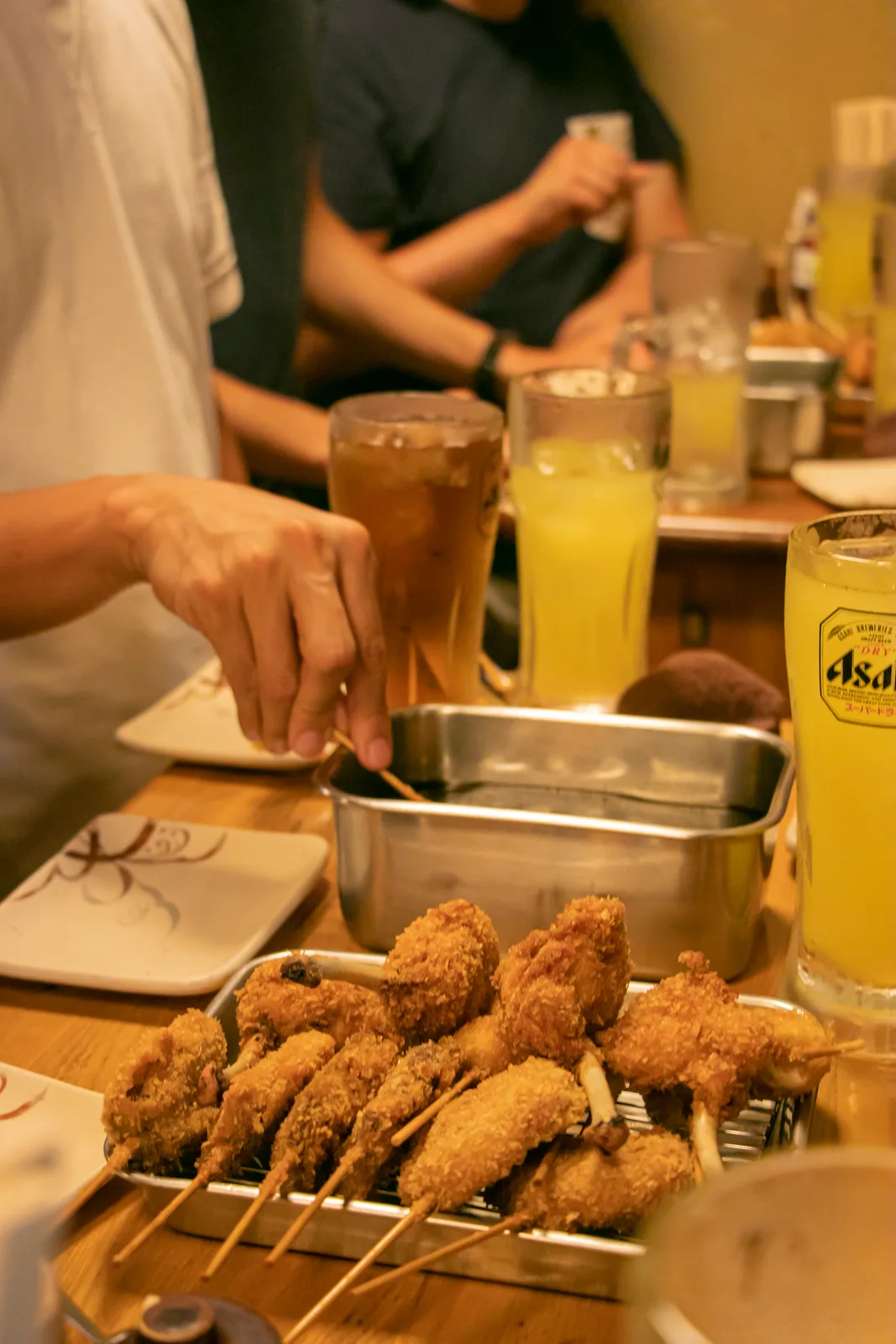
After an hour or so in Omoide Yokocho, walk five minutes east into Kabukicho. The main boulevard — Robot Restaurant is long gone, but the Toho Godzilla head and the neon remain — is worth walking slowly once. Touts will approach solo travelers; a brisk, polite 'no thank you' is sufficient. If you want to eat again, a standing kushiage bar is the move here: deep-fried skewers eaten upright with a cold beer, the way office workers do it on a Friday. The crowd is local, the bill is modest, and the contrast with the slick Kabukicho exteriors is the whole story. Our existing article on whether Kabukicho is safe at night addresses the questions most first-timers have — the short answer is that it is loud and commercial rather than dangerous.
One framing worth knowing: Kabukicho rewards a confident walk-through more than it rewards lingering. The restaurants, bars, and karaoke rooms aimed at tourists are obvious and easy to stumble into. The standing bars and izakayas worth your time are one block off the main drag — exactly the kind of place a local guide earns their keep finding. If you want that version of the neighborhood handled for you, our Shinjuku Food and Drink Night Tour starts at 17:30, covers Omoide Yokocho and a Kabukicho standing bar with all food and drinks included, and ends in Golden Gai — so you can use this itinerary as a DIY framework or let us run it for you.
9:00pm–midnight: Golden Gai
Golden Gai is six alleys and roughly 200 bars, most of them seating between five and twelve people. It sits about a five-minute walk northeast of Kabukicho and is the hardest part of this itinerary to do well independently. The challenge is not finding the alleys — they are well signposted now — but knowing which door to open. Many bars have a cover charge of ¥1000 or a set minimum spend, and some are effectively regulars-only without being rude about it. Others are genuinely welcoming to first-timers and actively good at the cross-cultural conversation that makes Golden Gai worth the trip. Our full comparison of Omoide Yokocho and Golden Gai explains what to expect inside each, including how to read whether a bar wants you.
The best approach: walk the alleys once without stopping, look at the handwritten signs and through the small windows, then pick the bar where the atmosphere looks right rather than the one with the biggest English sign outside. A drink runs ¥700–¥2000 depending on the bar and what you order. Most places stay open well past midnight, so there is no pressure to rush — and if you find a bar where the conversation is good, that is the only destination you need for the rest of the night.
A practical note on pacing: Golden Gai is genuinely better on a weekday or early in the weekend evening than after 11pm on a Friday or Saturday, when the alleys fill with larger groups and the intimate atmosphere that makes it special gets harder to find. Arriving around 9pm puts you there when it is busy enough to be alive but not so crowded that you're queuing outside every door.
Frequently asked questions
How do I get between these spots — do I need to take the train?
No. The Tokyo Metropolitan Government Building, Omoide Yokocho, Kabukicho, and Golden Gai are all within roughly 15 minutes of walking from each other. The observation deck is in Nishi-Shinjuku (west side); everything else is on the east side of the station. Google Maps works well for the short walks between them, and the route is flat the whole way.
What if I only have time for one stop — which should I prioritize?
Golden Gai, if you can only choose one and you are comfortable navigating it. The combination of the physical space, the age of the bars, and the conversations you can have there is genuinely unlike anywhere else in Tokyo. If you find small, dark, and bar-heavy less appealing, Omoide Yokocho is the more immediately accessible option — the food and atmosphere land fast, and it is easier to enjoy without any advance knowledge.
Is it safe to walk through Kabukicho alone at night?
Yes, for the vast majority of visitors. Kabukicho is Japan's largest entertainment district and extremely well policed. The main risk for solo travelers is persistent touts near the main boulevard — keep walking and decline firmly. The standing bars and izakayas one street back from the main drag are calm, busy with locals, and not a problem at all.
What is the cover charge situation at Golden Gai bars?
Many Golden Gai bars charge a cover fee — often around ¥1000 — which is standard practice there and covers the bar's tiny overhead. It is not an entry fee for being foreign; it is how the economics of a five-seat bar work. Some bars also have a minimum drink spend. Check the sign outside, or just ask before you sit down. Any bar worth your evening will tell you clearly.
More local guides
- Is Kabukicho Safe at Night? (And Is It Dangerous?) — A Local's Honest Answer →
- Is Golden Gai a Tourist Trap? No — Here's the Real Guide for First-Timers →
- Is Tsukiji Still Worth Visiting? What Actually Moved to Toyosu →
- Omoide Yokocho vs Golden Gai: Which Should You Visit? →
- Tokyo Izakaya Etiquette: The Rules First-Timers Actually Need →
- Are Tokyo Food Tours Worth It? An Honest Answer from Guides →
- Visiting Meiji Shrine: Etiquette, Best Time & What to Expect | Tokyo Local Guide →
- What Is an Izakaya? How It Differs from a Bar or Restaurant →
- Is Tokyo Nightlife Fun as a Solo Traveler? (Yes — Here's Why It Works) →
- What Is Nomihodai? Japanese Drinking Culture Rules Explained →
- What to Eat at Tsukiji Outer Market: A Must-Try List →
- Shimokitazawa, Koenji & Nakano: Where Young Tokyo Actually Hangs Out →
- What Can You Do on a Private Tokyo Tour? Real Examples & How It Works →
- Do You Tip in Tokyo? Restaurants, Taxis, Guides & Hotels Explained →
- How to Find Local Experiences in Tokyo (Without the Tourist Traps) →