The short answer
In Tokyo, “local” rarely means hidden — it means small and unsigned. The real neighborhood life happens at eight-seat izakaya counters, along shotengai (shopping streets) built around ordinary train stations, in shrines at 7 a.m., and in yokocho alleys where the menu is handwritten in Japanese. You find it by changing two things: where you look (one or two stops past the famous stations) and when you look (before 10 a.m. or after 9 p.m., on weekdays). Then use the tools Tokyo residents use — Google Maps searched in Japanese, Tabelog scores read the local way, and the willingness to walk into a place with no English sign. For your first night, the fastest shortcut is a person who already knows which door to open — that is the one thing no app can replace.
What “local” actually means in Tokyo
Travelers often arrive expecting Tokyo to hide its local life somewhere secret. It doesn’t. Greater Tokyo is home to roughly 37 million people, and almost all of them live in neighborhoods that work like small towns: a station, a shopping street (shotengai) leading away from it, a handful of izakayas, a public bath (sento), a shrine, a ramen counter that has served the same block for decades. The famous Tokyo — Shibuya Crossing, Senso-ji, the neon of Shinjuku’s main streets — is real, but it is where the city performs. Local Tokyo is where it lives, and it is everywhere, in plain sight, ten minutes from wherever you are standing.
The reason it feels invisible is scale and signage. The best places are tiny (six to twelve seats is normal), family-run, and often have no website, no English sign, and a menu written by hand in kanji. They are not hiding from you; they simply were never built for visitors, because until recently they never had any. Nobody is going to wave you in. Understanding that one fact changes how you search: you stop looking for “hidden gems” on lists and start looking for the ordinary, unadvertised places that make up most of the city.
One more mental adjustment: a local experience in Tokyo is usually quiet. It is a counter where the owner remembers your order, a morning shrine walk with commuters bowing on their way to work, a shopping street where the tofu shop and the croquette stand have queues of grandmothers, not tourists. If you are looking for spectacle, the famous districts already do that brilliantly. If you are looking for the texture of daily life, adjust your expectations toward small, slow, and slightly awkward — and then it becomes easy to find.
Change where you look: one or two stops past the famous station
The single most effective technique is also the simplest. Take the train one or two stops beyond the station everyone visits, get off, and follow the shotengai. From Shibuya, that means Shimokitazawa (four minutes away) for vintage clothes, tiny theaters, and curry. From Shinjuku on the Chuo line, it means Nakano (one stop) for the pop-culture arcades of Broadway and Koenji (about seven minutes) for live music and old-school izakayas. From Ueno, walk north to Yanaka, where the Yanaka Ginza shopping street still has the rhythm of 1960s Tokyo. East across the river, Kiyosumi-Shirakawa, Monzen-Nakacho, and Kuramae combine coffee roasters, temple neighborhoods, and craft studios. Our guide to Shimokitazawa, Koenji, and Nakano covers the west side in detail.
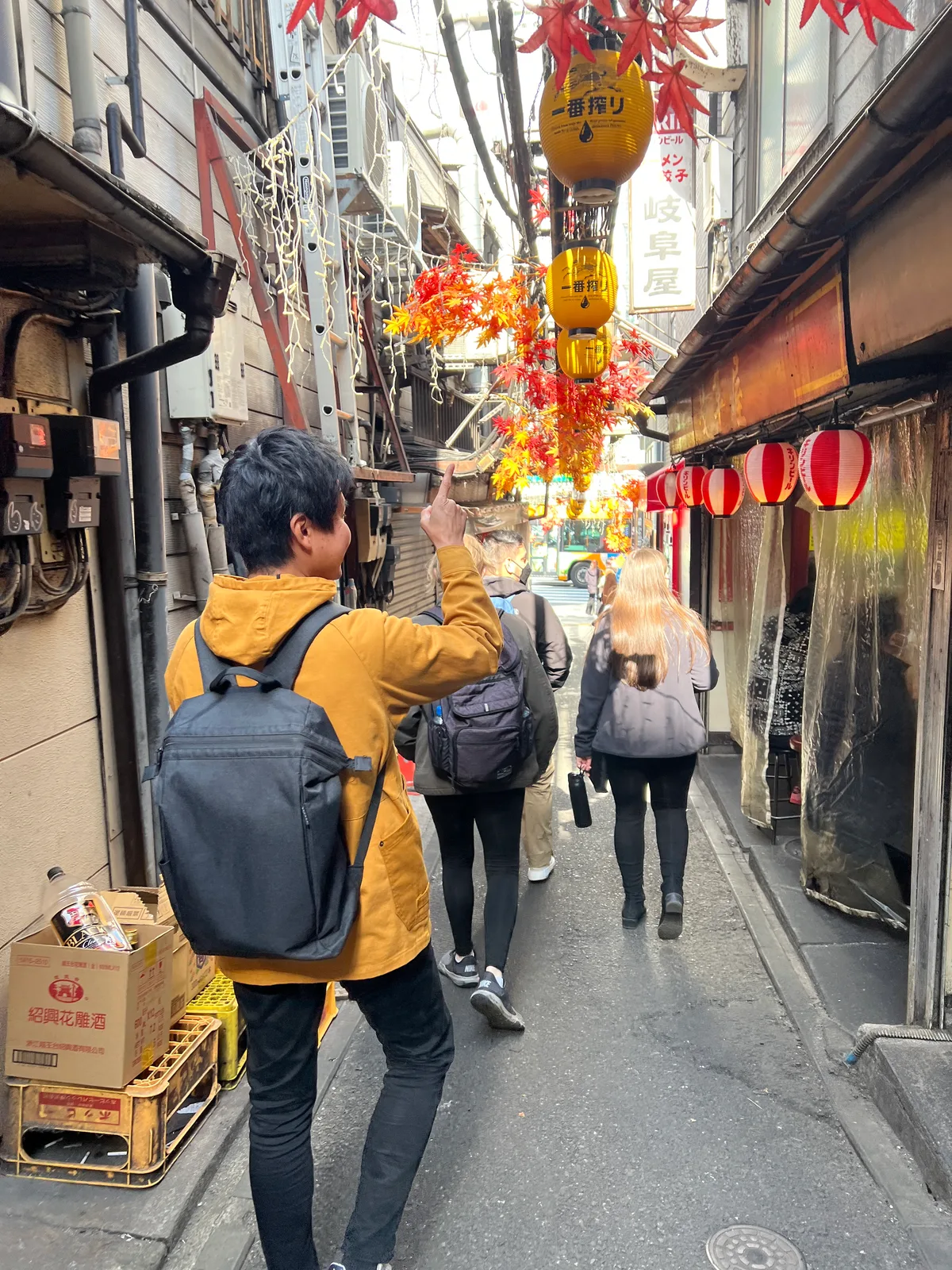
Learn one Japanese word: yokocho, which means a narrow lane of tiny bars and eateries. Tokyo has dozens, and they are the most concentrated local drinking culture in the city. Omoide Yokocho in Shinjuku and Nonbei Yokocho in Shibuya are the famous ones; Harmonica Yokocho in Kichijoji and the streets under the train tracks (gado-shita) in Yurakucho, Nakameguro, and Akabane are where more residents actually drink. Our article comparing Omoide Yokocho and Golden Gai explains how the famous two work; the same logic — sit at the counter, order a drink first, share small plates — applies in every yokocho in Japan.
A caution about “hidden gem” content online: by the time a spot reaches Instagram, TikTok, or a listicle, it is no longer hidden, and the queue outside proves it. That does not make those places bad — several are excellent — but they are not the local experience you were promised. If a place has a line of foreign visitors at 11 a.m., the local version of it is usually two streets away with no line at all.
Change when you look: Tokyo runs on local hours
Tokyo neighborhoods have a daily rhythm, and most visitors are out of sync with it. Mornings belong to locals. Meiji Shrine opens at sunrise, and the first two hours are when commuters stop to bow and the 100,000-tree forest is genuinely quiet; by 11 a.m. the same path is a procession. Tsukiji Outer Market is at its best around 8 a.m., when stalls open and restaurant buyers are still shopping; by noon the best items are gone and the crowd has tripled. Set one early alarm on your trip and you will see a version of the city most people never do.
Evenings have their own schedule. Izakayas open around 17:00 and fill with office workers from about 18:30 — arriving before 19:00 on a weekday is the best way to get a counter seat without a reservation. Golden Gai’s bars are dead until 21:00 and alive after 22:00. Sundays are quieter everywhere, and many small independent shops and yokocho counters close entirely, so plan neighborhood exploring for weekdays and Saturdays when you can.
Finally, watch the calendar. Summer is festival season: neighborhood matsuri and bon odori dances happen almost every weekend in July and August, mostly at local shrines with no tourist presence at all, and Koenji’s Awa Odori in late August draws roughly a million people to a residential neighborhood. Cherry blossom season (late March to early April) turns every neighborhood park into an evening picnic. These are the most local experiences in Tokyo, and they cost nothing — the only trick is being in the right neighborhood on the right night.
The tools Tokyo residents actually use
Search Google Maps in Japanese, not English. Typing 居酒屋 (izakaya), 定食 (set meal), 喫茶店 (old-style café), or 銭湯 (public bath) surfaces the places that never bothered to register an English name, and the review count tells you instantly whether visitors have found it. A place with 60 reviews, all in Japanese, is usually exactly what you are looking for. Copy the kanji from this page if you cannot type it — it works.
Learn to read Tabelog, Japan’s dominant restaurant review site, the way locals do. Its scores are deliberately conservative: anything above 3.5 puts a restaurant in roughly the top few percent nationally, and a 3.2 is a perfectly good neighborhood spot. Travelers who apply Google’s 4.5-or-nothing rule to Tabelog end up ignoring most of the best food in the city. Tabelog also has an English interface, but the Japanese one lists far more places.
The oldest tool is still the best: ask. Bartenders and izakaya owners in Japan are proud of their neighborhoods, and “next place?” with a hopeful expression will get you a hand-drawn map or a phone call to a friend’s bar more often than you would expect. The police boxes (koban) on most corners will happily point you to the local sento. And a few words of Japanese — sumimasen (excuse me), osusume wa? (what do you recommend?), kore kudasai (this one, please) — carry you through almost any counter in the city.
When a local-led tour is the shortcut — and how to tell a real one
Honest answer first: you do not need a tour to find local Tokyo. Everything above works on your own, and if you have two weeks and enjoy the research, do it yourself. A tour earns its price in specific situations: your first night, when jet lag and an unfamiliar rail map make walking into a kanji-only izakaya feel impossible; the alleys where the best counters have eight seats and the owner decides who sits down; dietary restrictions you cannot yet explain in Japanese; or traveling solo and wanting company for one evening. Our article on whether Tokyo food tours are worth it goes deeper on that trade-off.
If you do book one, a few questions separate a genuinely local-led experience from a repackaged one. Who is actually guiding — a resident of the city, or a contractor the company has never met? Is the group small enough (ten or fewer) to fit inside a real neighborhood venue rather than a restaurant with a tour-bus entrance? Do the venues have English menus — because if they all do, you could have found them yourself? Do reviews mention guides by name? And does the guide send you away with recommendations for the rest of your trip? That last one is the real test: a good local wants you to be able to do this without them tomorrow.
Whichever way you go, do it early in your stay. One evening at a local counter on day one — with a friend, a guide, or just your own nerve — teaches you how to order, what the small automatic appetizer is, and how to read a room. Everything after that gets easier, and by the end of the week you will be the one telling other travelers where the locals go.
Frequently asked questions
Which Tokyo neighborhoods are best for local experiences?
For a first trip, four areas reliably deliver: Shimokitazawa (vintage shops, small theaters, four minutes from Shibuya), Koenji and Nakano on the Chuo line (live music, old izakayas, pop-culture arcades), Yanaka near Ueno (an old-town shopping street and temple district), and Kiyosumi-Shirakawa across the river (coffee roasters and galleries). For evenings, any yokocho alley — Omoide Yokocho, Harmonica Yokocho in Kichijoji, or the bars under the tracks in Yurakucho — will put you at a counter next to residents.
Can I find local places in Tokyo without speaking Japanese?
Yes. Search Google Maps using Japanese keywords (copy 居酒屋 for izakaya or 定食 for set-meal restaurants), point at menus or at what the person next to you is eating, and learn three phrases: sumimasen (excuse me), osusume wa? (what do you recommend?), and kore kudasai (this one, please). Staff at small places are used to gestures and are far more welcoming than travelers fear. Where language genuinely blocks you — allergies, detailed dietary needs, reservations by phone — a local friend or guide removes the barrier.
How do I know if a Tokyo restaurant or bar is a tourist trap?
Three warning signs: a tout inviting you in from the street (legitimate places in Tokyo never do this), a menu with photos in five languages and no prices posted, and a queue that is entirely foreign visitors while the identical shop next door is empty. Positive signs: handwritten menus, Japanese-only reviews on Google Maps, a Tabelog score of 3.3 or higher, and office workers at the counter after 18:30. A small seat charge (otoshi, ¥300–¥800) is normal and not a scam.
Are “tours by locals” in Tokyo really led by locals?
Not always — many listings on big booking platforms are resold to third-party guides the company has never met. Check who guides before you book: the website should name the guides and show they live in Tokyo, groups should be capped around ten, reviews should mention guides by name, and the itinerary should include at least one venue without an English menu. Our tours are led only by our own team of Tokyo residents, and every guide leaves you with a list for the rest of your trip.
More local guides
- Is Kabukicho Safe at Night? (And Is It Dangerous?) — A Local's Honest Answer →
- Golden Gai for First-Timers: Etiquette, Cover Charges & How to Pick a Bar →
- Is Tsukiji Still Worth Visiting? What Actually Moved to Toyosu →
- Omoide Yokocho vs Golden Gai: Which Should You Visit? →
- Tokyo Izakaya Etiquette: The Rules First-Timers Actually Need →
- Are Tokyo Food Tours Worth It? An Honest Answer from Guides →
- Visiting Meiji Shrine: Best Time, Etiquette & What Not to Do →
- What Is an Izakaya? How It Differs from a Bar or Restaurant →
- Is Tokyo Nightlife Fun as a Solo Traveler? (Yes — Here's Why It Works) →
- What Is Nomihodai? Japanese Drinking Culture Rules Explained →
- What to Eat at Tsukiji Outer Market: A Must-Try List →
- Shimokitazawa, Koenji & Nakano: Where Young Tokyo Actually Hangs Out →
- What Can You Do on a Private Tokyo Tour? Real Examples & How It Works →
- Do You Tip in Tokyo? Restaurants, Taxis, Guides & Hotels Explained →