The short answer
An izakaya is a Japanese drinking establishment where food is just as important as the drinks — closer in spirit to a gastropub than either a bar or a sit-down restaurant. You order multiple small sharing dishes (called otsumami or sakana) alongside beer, sake, shochu, or highballs, and the evening unfolds at whatever pace the table sets. Unlike a Western bar, food is central to the experience, not an afterthought; unlike a restaurant, you are not expected to eat a structured meal and leave. Izakayas range from tiny counter-seat spots with eight stools to large chain venues seating hundreds, but the social logic is the same: stay as long as you like, keep ordering, and share everything.
Izakaya vs bar vs restaurant: the key differences
The clearest way to understand an izakaya is to map it against the two Western categories it sits between. A bar's primary product is drinks; food, if it exists, is secondary. A restaurant's primary product is a meal eaten in courses; drinks support the food. An izakaya treats both as equal — you would not visit one just to drink, and you would not visit one expecting a tidy three-course structure. Think of a long table covered in small plates, everyone reaching across, nobody tracking whose round it is.
Practically speaking, this affects almost every detail of the experience. Izakayas typically charge a small cover (called otoshi or tsukidashi) of roughly ¥300–¥600 per person, which arrives as a tiny appetizer you did not order — a way of confirming your table. Western bars rarely do this; restaurants never do. Menus are broad and designed for grazing: edamame, yakitori skewers, karaage, tofu, grilled fish, salads, fried rice — a good izakaya kitchen can produce thirty or forty distinct dishes. Drink orders are frequent and informal, and most places offer all-you-can-drink packages (nomi-hodai) for a fixed price over a set time window.
One more distinction worth knowing: izakayas are fundamentally communal spaces. The Japanese word breaks down as 'i' (to stay) plus 'sakaya' (sake shop) — a place to linger over drinks. After-work groups, friend circles, and company parties fill them nightly. Turning up as a solo traveler or a small group of two is completely normal at the counter-seat style, but the vibe is social rather than quiet.
Types of izakaya you will actually encounter in Tokyo
The broadest split is between chain izakayas and independent ones. Chains like Watami, Torikizoku, and Shirokiya are found near most major stations, often have picture menus in English or with photos, and offer reliable, affordable food — useful if you want a low-pressure first experience. Independent izakayas are where the character lives: a charcoal grill behind a counter of six seats, a handwritten menu on the wall, a proprietor who has been running the same spot for thirty years. These are harder to walk into cold, especially if there is no English menu, but the food and atmosphere are usually several steps up.
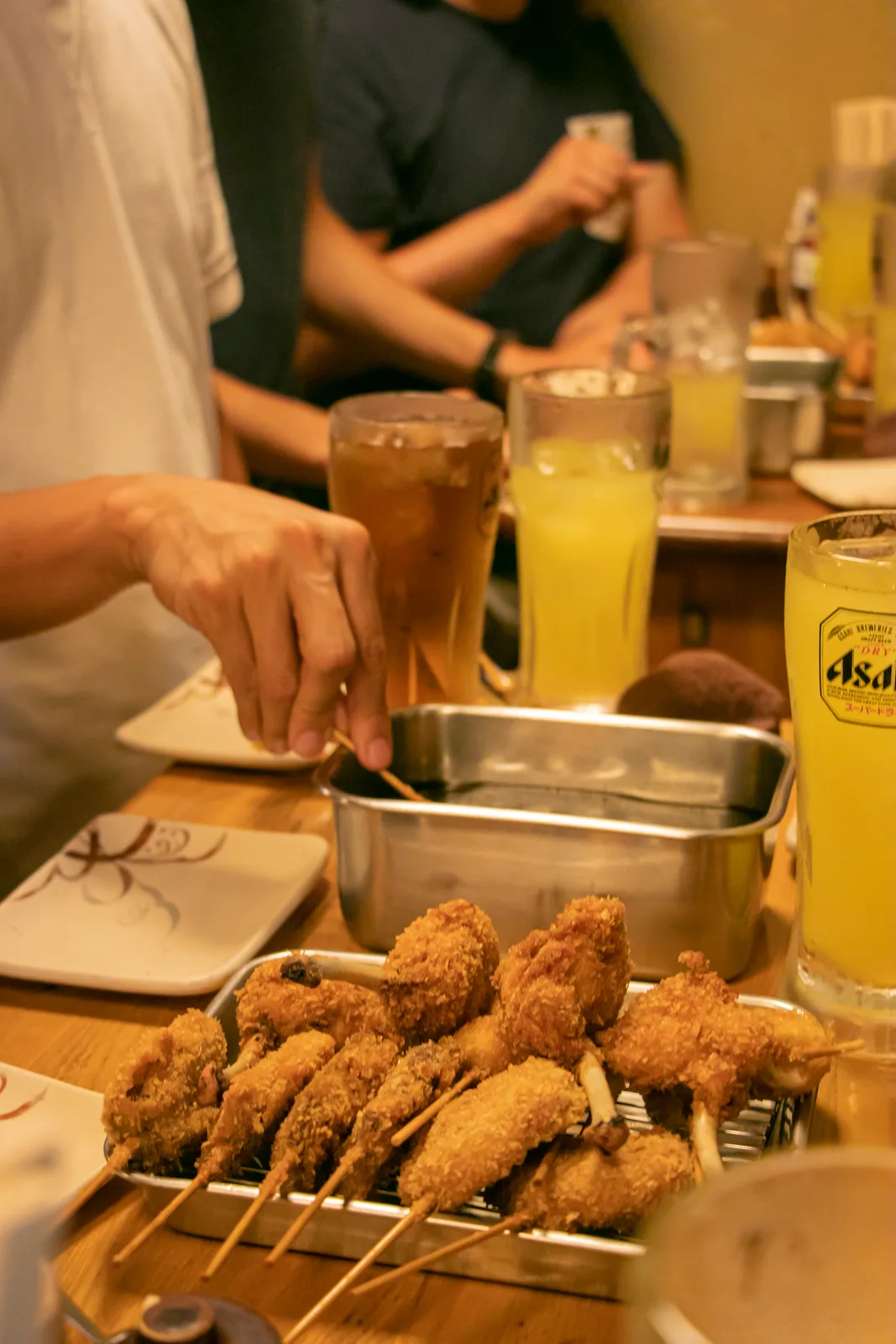
Within independents, a few subtypes recur. Yakitori-ya specialize in grilled chicken skewers; robatayaki spots grill everything over open charcoal; kushiage bars (common in Osaka, increasingly in Tokyo too) deep-fry skewered meat and vegetables. Omoide Yokocho in Shinjuku is one of the densest concentrations of tiny yakitori izakayas in the city, packed into a narrow postwar alley — the kind of place our Shinjuku food and nightlife tour is built around, because it is genuinely difficult to navigate without knowing which door to open and what to say when you sit down.
Golden Gai is a related but distinct category worth separating: its 200-plus bars are individually tiny and themed, operated more like curated cocktail bars than food-forward izakayas. If you want to understand the full spectrum of Tokyo nightlife — izakaya, standing bar, Golden Gai — our article on Omoide Yokocho vs Golden Gai walks through the differences, and our separate izakaya etiquette guide covers the rules of conduct in detail so you do not need to repeat that ground here.
What to order and what to expect on your first visit
Arrive with at least one other person if possible — sharing is the point. The first order is almost always drinks, and you will often be asked for a drink order before you have even looked at the food menu. Beer (nama biru, meaning draft) is the default opener for many groups; a lemon sour (shochu with soda and lemon) or highball (whisky and soda) are equally common. Once drinks arrive, start building the table: edamame to snack on immediately, a couple of skewers from the grill, maybe a cold tofu dish. Then keep going. There is no right number of dishes — the evening is self-pacing.
Prices vary considerably by venue. At a mid-range independent izakaya, expect individual dishes to run ¥400–¥1,200 and drinks ¥400–¥700 each. A full evening with several rounds of drinks and a broad spread of food might come to ¥2,500–¥4,500 per person, though that number climbs quickly at premium spots. Chains are consistently cheaper. Payment is almost always at the end of the meal as a single bill for the table, not round by round — the server will ask if you want to split (betsu-betsu) or pay together (issho) when you call for the check (o-kaikei, or just making a writing gesture in the air).
One practical note on timing: izakayas open in the early evening, typically from around 17:00 or 18:00, and most close well after midnight. Some require a reservation for weekend evenings, particularly the smaller counter-seat spots. If you are planning to walk in without one, a weekday is safer, and arriving before 19:00 gives you the best chance of a seat.
Frequently asked questions
Is an izakaya expensive?
Not usually. At a mid-range Tokyo izakaya, most people spend ¥2,500–¥4,500 per person for a full evening including drinks and several shared dishes. Chain izakayas are cheaper still. Premium or craft-focused spots can run higher, but an izakaya is fundamentally an everyday social venue, not a splurge destination.
Can I go to an izakaya alone?
Yes, especially at counter-seat (カウンター) style izakayas, where solo diners sit along a bar facing the kitchen. It is common, comfortable, and a genuinely good way to eat and drink in Tokyo on your own. Large group-table-style izakayas are less suited to solo visits purely for practical reasons — you are paying for a lot of food you cannot finish alone.
Do I need to speak Japanese to visit an izakaya?
Chain izakayas often have picture menus or tablet ordering systems, making them easy to use without any Japanese. Independent izakayas can be trickier — menus are handwritten in kanji, and staff may not speak English. Pointing, photos on your phone, and a few basic phrases ("kore" for "this one", "kudasai" for "please") go a long way. Going with a local guide removes that friction entirely.
What is the small dish that arrives automatically when I sit down?
That is the otoshi or tsukidashi — a small automatic appetizer that signals your table is confirmed. It is charged to your bill (typically ¥300–¥600 per person) regardless of whether you asked for it. Think of it as the izakaya equivalent of a cover charge. You can eat it or leave it, but you will pay for it either way.
More local guides
- Is Kabukicho Safe at Night? (And Is It Dangerous?) — A Local's Honest Answer →
- Golden Gai for First-Timers: Etiquette, Cover Charges & How to Pick a Bar →
- Is Tsukiji Still Worth Visiting? What Actually Moved to Toyosu →
- Omoide Yokocho vs Golden Gai: Which Should You Visit? →
- Tokyo Izakaya Etiquette: The Rules First-Timers Actually Need →
- Are Tokyo Food Tours Worth It? An Honest Answer from Guides →
- Visiting Meiji Shrine: Best Time, Etiquette & What Not to Do →
- Is Tokyo Nightlife Fun as a Solo Traveler? (Yes — Here's Why It Works) →
- What Is Nomihodai? Japanese Drinking Culture Rules Explained →
- What to Eat at Tsukiji Outer Market: A Must-Try List →
- Shimokitazawa, Koenji & Nakano: Where Young Tokyo Actually Hangs Out →
- What Can You Do on a Private Tokyo Tour? Real Examples & How It Works →
- Do You Tip in Tokyo? Restaurants, Taxis, Guides & Hotels Explained →
- How to Find Local Experiences in Tokyo (Without the Tourist Traps) →